
UNDERSTANDING COFDM: THE BACKBONE OF RELIABLE TACTICAL VIDEO LINKS
What Is COFDM?
At its core, COFDM is a modulation technique that splits a single data stream into hundreds (or even thousands) of narrowband sub-carriers.
Each sub-carrier transmits part of the data in parallel, at slightly different frequencies. Because these sub-carriers are orthogonal, they don’t interfere with each other, which means maximum data throughput and resilience even when the radio channel is full of reflections, obstacles, or movement.
In simpler terms:
COFDM spreads your video data across multiple lanes of a digital motorway, if one lane gets blocked, the others keep traffic moving.
Why It Matters for Tactical Teams
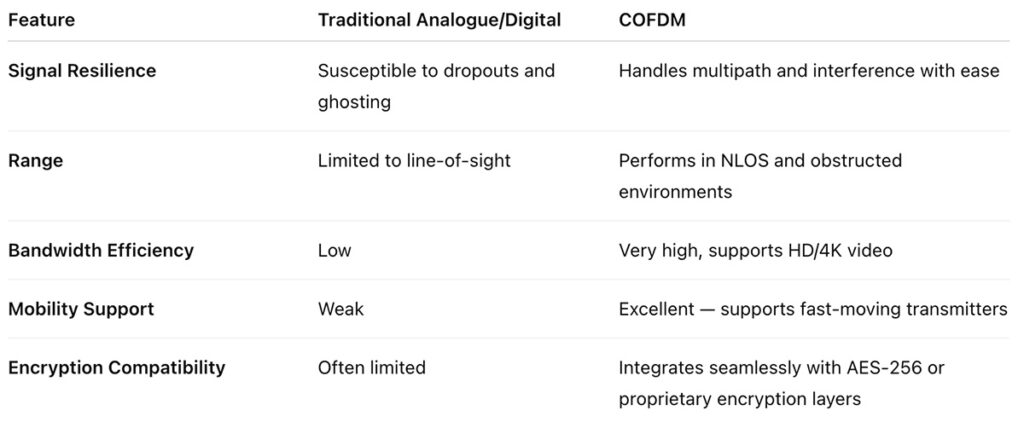
In the field, environments are rarely ideal. Buildings, vehicles, trees, or terrain can all cause multi-path interference (signals bouncing back at slightly different times). Conventional analogue or narrowband systems can’t cope with this — they drop packets, freeze video, or lose sync.
COFDM, however, thrives in such conditions.
- Stable HD video in non-line-of-sight (NLOS) environments
- Extended range through robust error correction
- Low latency, essential for live command decisions
- Mobility support, even for moving transmitters such as drones, vehicles, or body-worn units
This is why COFDM has become the standard for live broadcast, defence, and public safety communications worldwide.
COFDM vs Traditional Transmission
Real-World Application
- Search and Rescue (SAR): Stable drone-to-ground HD video through forests or collapsed structures.
- Law Enforcement & Intelligence: Live covert video from vehicles or body-cams, even in dense urban areas.
- Military & Naval Units: Persistent situational awareness where satellite coverage is unreliable.
When paired with mesh networking, COFDM becomes even more powerful, enabling multi-hop video relay across mobile teams without a single point of failure.
Whats next
As sensor data, AI-based analytics, and augmented reality overlays become more common, the demand for high-bandwidth, low-latency links will only grow.
COFDM will continue to play a key role, especially when combined with mesh radios, edge processors, and hybrid satellite-cellular integrations.
COFDM isn’t just a transmission technology, it’s the silent enabler of mission success.